Students Who Shine, Students Who Sink
Every teacher has favourite students. And although the same children tend to be favoured by everyone as they move through the grades, every teacher has different styles and personalities, and thus would probably favour certain types of students more than other teachers would.
Reluctantly assuming the role of armchair psychologist for a moment, I have noticed that we tend to be most agitated by students behaving in ways that send us back to our younger selves. An esteemed colleague, for example, had a very tough childhood. Raised in a traditional farming family in Vietnam, she was socialised to be a very good girl. Hardworking and polite, were she to fail at her obligations and responsibilities, she would be severely reprimanded or beaten. Now her favourite students are the most polite ones: those who always say “hello teacher, goodbye teacher” without being prompted, who always ask permission when they need to drink water or eat a snack from the snack box at the language centre where we work together.
For me, my family was made up of my two parents, who were artists, and a rotating cast of diverse people from all over the place constantly coming and going, part of the theatre troupe my father ran at the time. My parents did not let me get away with everything; they raised me properly, which is to say I learned all the standard etiquette any child would have learned growing up where I was from. But I was never beaten and only rarely reprimanded strongly if I forgot some chore or didn’t clean my room in a timely manner. So yes, I appreciate when students are polite, and it is important for us to teach them to be, if only because they will be more successful if they are liked by the people they meet as they move through the world. But I also really like students who are more left-field: the quiet ones, the sensitive ones who speak in murmurs, the bandits already halfway out the window in their minds.
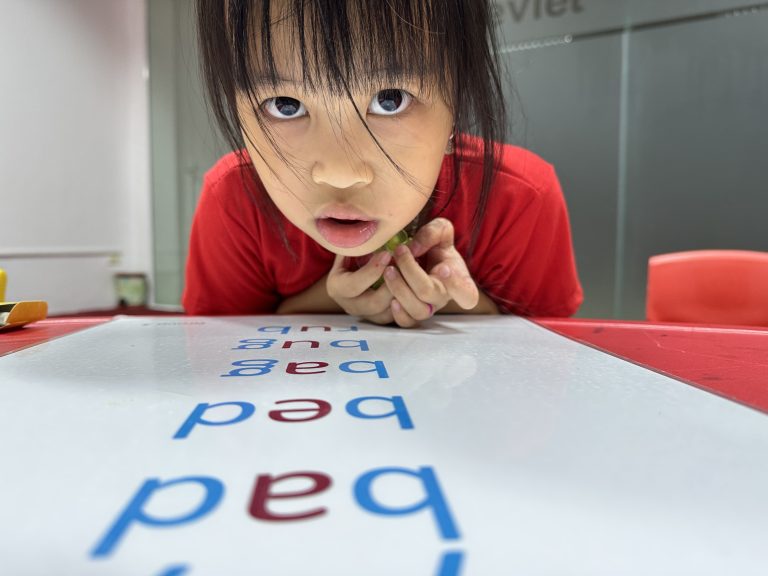
Enters Hân, eight years old A very quiet, almost despondent little girl who never smiled. Easy to miss or ignore, her black eyes always fixed in front of her, slightly below the horizon. When given the opportunity to speak, her voice was the whisper of a mouse. She was a cute kid with a stone cold face, and one day, when her neighbour did something that must have crossed a line, she slowly and deliberately raised her little fist to punch him, staring him down, knowing he wouldn’t retaliate. I found that cold calculated little punch so hilarious at the time that I laughed about it for weeks afterward, teasing the offending party and wondering aloud what he must have done to deserve the punishment.
Little by little she started to smile and participate more. I had other students use valorising adjectives while describing her as part of our usual exercises. I wanted to bring her within the group, to let her be not only the target of jokes but also an actor within our short thirty-five-minute weekly performance with agency, a personality, and colour that was her own. Not based on some imaginary model student that she was capable of following but that did not, to my mind anyway, provide any intrinsic motivation for her to come out of her shell.
A year later, with Tết approaching, Hân ran toward me to give me a makeshift little present she had fashioned out of paper in class, containing a sweet she had saved. The gift read: “Happy new year.” She thrust it into my hands and bolted, swallowed up by the after-school tide of bicycles and motorbikes before I could say a word.
As a child I remember wanting to jump out the window, forced to sit in a chair at school all day while the whole world was out there waiting to be explored. After primary school, being a student in the public education system felt like pure drudgery. I was quite depressed and could not understand (and still to some extent cannot understand) why making people sit for eight hours is the best way to flourish, enjoy life, or even learn, especially as more effective models of instruction are slowly being discovered around the world: approaches that maximise learning of skills and not only of academic subjects that may not suit everyone. But that is another topic for another essay.
What I want to examine here is what my favourite students have taught me. I regard the bond between student and teacher as something sacred. Although I don’t think my intervention is a matter of life and death, I still hold my position as one of great responsibility and privilege, especially as a guest in this strange and beautiful country. Every student who enters my class can expect me to stick up for them, and I will do what I can to help. Of course, the level of involvement I can have with my students is limited by a number of factors.
First is time. It is limited in the public schools, and paying attention to every single student requires enormous effort when classes can reach forty children. However, over time they learn to trust me and understand that I have their best interests at heart. When they see that I understand the relationships of power, love, hate, and all the other dynamics present in the classroom, and that I can play with those tensions to make them laugh, help shy students come out of their shells, or limit the influence a bully has on others, slowly they learn to put their trust in me.
Second is the child’s own will. Although I spend a great deal of energy trying to create genuine connection with my students, especially those who are hard to reach, I have come to recognise that a fruitful relationship between educator and learner cannot be forced. Some children need more time. Others have decided it is absolutely not worth their while to consider you interesting or worthy of being part of their lives. It is better to take this in stride, with a little humour, even though it sometimes stings.
Third is the child’s family. I have been here long enough to form strong bonds with some students and their families. They invite me to dinners and birthday parties, and I do my best to offer something of worth in return for the chance to peer into a world seldom seen by tourists or even by teachers who have been here longer than I have. I hold this privilege carefully. I am not a tourist, and my duties as an educator come first, even as I become a friend to the family. I am also a foreign object entering my students’ most intimate sphere, and I feel the weight of ensuring the experience is a good one for everyone. These families come from a world far removed from my own upbringing among the intellectual artistic class of European capitals. Most are working class, some barely a generation removed from poverty. Yet their kindness, their honesty, and their patience with my inevitable missteps more than bridge whatever cultural distance lies between us.
The point is that I have a different level of engagement with every student in my class, ranging from those who have decided to ignore me completely and remain beyond my reach, to those whose families have kindly allowed me to share in their lives outside school. One might expect my attention in the classroom to be biased toward these latter children. I have found the opposite to be true.
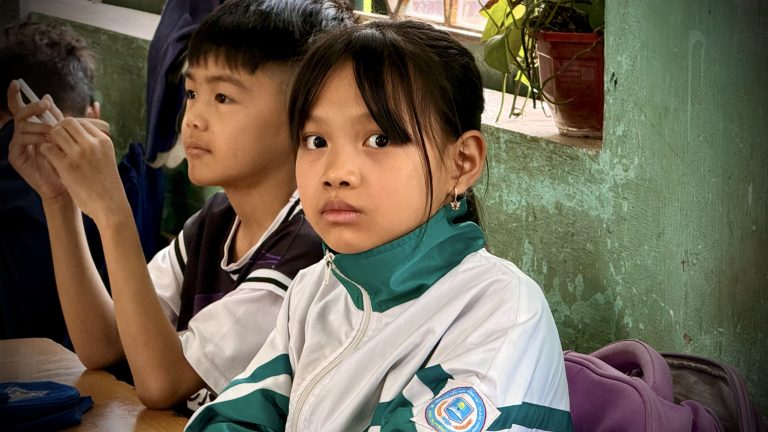
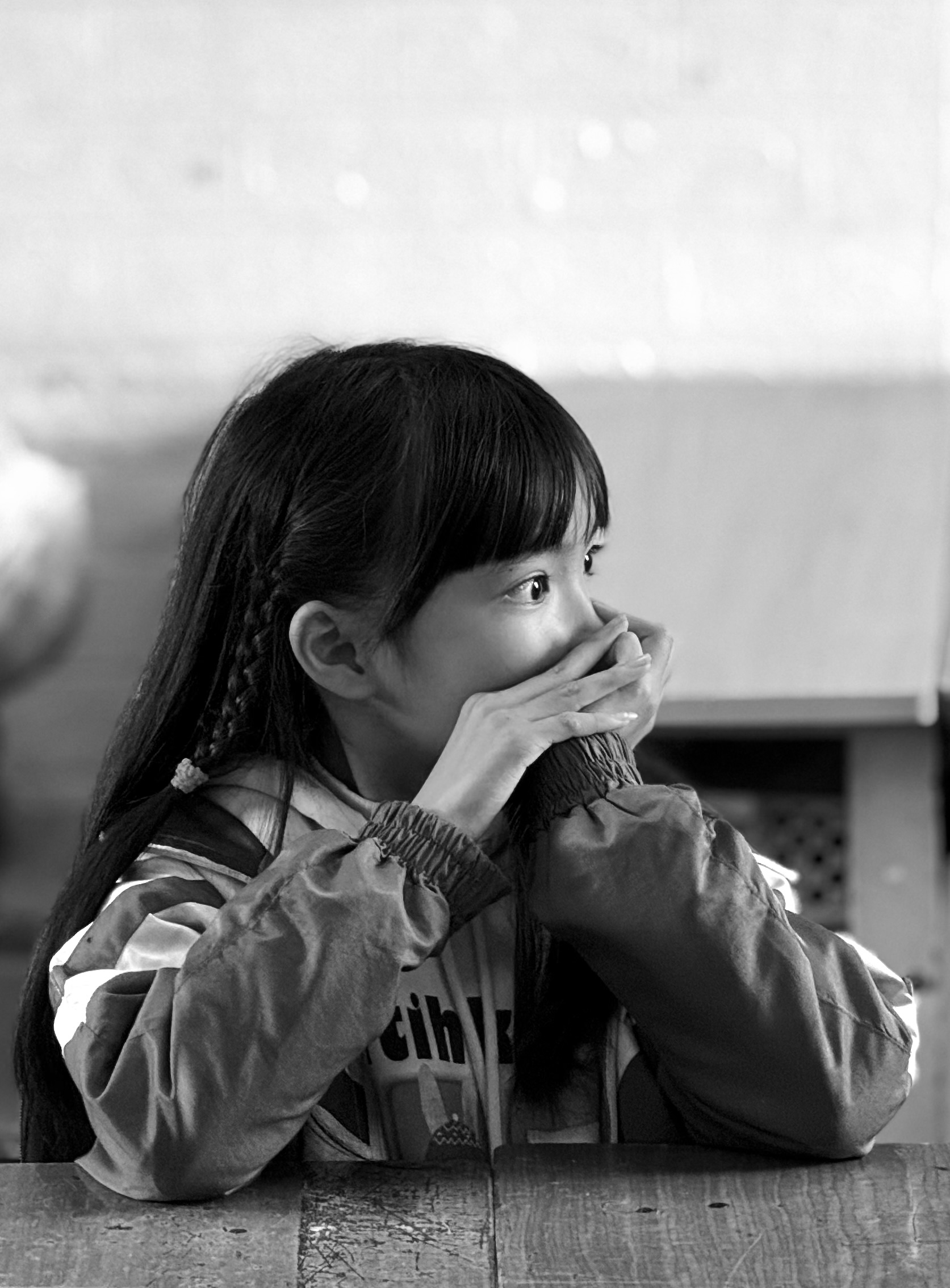
The affection I feel for certain students contrasts sharply with those who do not possess any natural ability to reach out and endear themselves to a teacher. Perhaps they are not as cute, at least in their own estimation. Perhaps they lack social skills or confidence or they have trouble at home. Whatever the reason, they fail to stand out in a way that gets them picked up and lifted away from the crowd, positioned to benefit from privileged relationships with adults who might help them. Often these children go unnoticed. The workload of teachers is so heavy that it is tempting to assume everything is fine. At least they are not causing trouble.
I have found that the closer relationships I have woven with my favourite students, the more those children sinking into the background have come to the forefront of my attention. It is not guilt exactly, but more an awareness of the reasons these children do not stand out. I find myself trying to understand and undo whatever made them unable to flourish and express themselves, so they might partake in the joy I am hopefully eliciting in the class.
Although I succeeded with Hân in effecting some kind of change, I must admit that many students remain beyond my reach due to constraints of time, but also due to their own will, or because I failed at an intervention I was attempting. Perhaps I was too loud and bombastic, or didn’t pay close enough attention. Time is a major factor here. I do not have the luxury of eight hours in a classroom every day of the week as homeroom teachers do, so I sometimes faceplant and have to accept temporary defeat.
In the end, I do not really know why having developed deep bonds with some of my students has made me a better teacher toward those who don’t seem to have a voice. It may just be that I am simply trying to recapture some past success or maybe it is just stubbornness.
It is difficult to accept It is difficult to accept when nothing lands. I sometimes feel as an amateur boxer sparring for the first time. The target is in view and the goal seems simple enough but the timing is wrong and all my flailing comes to nothing as the only thing I can hit is the space between me and them. I once spent an entire year gently battling a student who refused to remove her mask convinced of some facial flaw invisible to everyone but herself. All to see her walk in the classroom the following year without a mask as if nothing happened, greeting me with a big smile. Sometimes all my gesticulating is in vain. All they needed was time and the input of others in their lives. I do feel a little silly sometimes, spending so much energy when in fact my participation is not required at all for the desired outcome.
This job is a constantly humbling experience, but when it works, when a child who never spoke suddenly runs toward you with a paper gift, it feels like a heroic victory even if no one else notices.